Substantive Post #1: Theories of Multimedia Learning
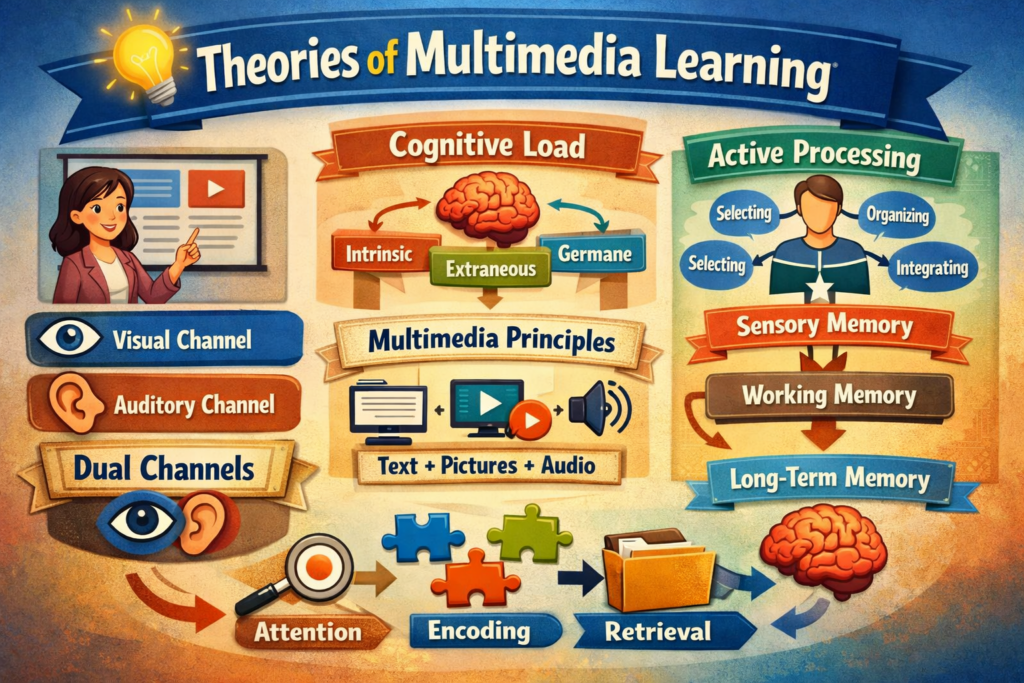
Intuitive and Unexpected Principles of Multimedia Learning
While reading the principles of Cognitive Theory of Multimedia Learning, there were many principles that were quite intuitive to me. One such principle is the Coherence Principle. When I was younger, I used to add unnecessary information to presentations (i.e., memes) to make the presentation more engaging and entertaining for the audience. However, I quickly learned that by doing so, it made it so that the audience would pay more attention to the extraneous information, rather than the information I was trying to convey. This experience helped me realize that engagement does not necessarily come from added entertainment, but from clarity/relevance. Despite many intuitive principles, there is one principle that surprised me: The Voice Principle. As someone who listens to audio books, I always found that a more formal, computer-generated voice would be just as effective as a human voice. However, learning about the Voice Principle made me think otherwise. Ultimately, re-thinking made me agree with this principle. A spoken human voice has more expression and personality, making it easier to pay attention and making learning more engaging.
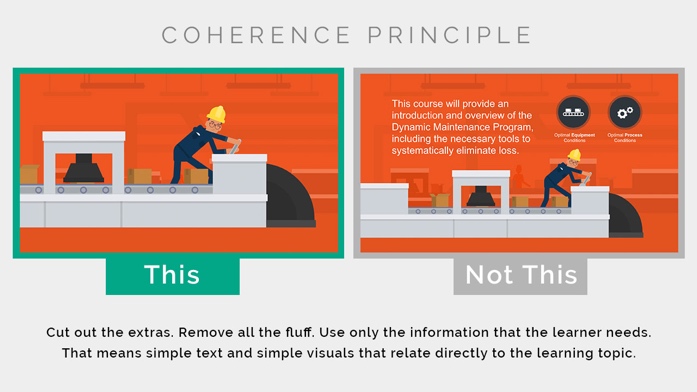
Applying Multimedia Learning Principles to My Projects
When it comes to creating my own project, four main principles stand out to make learning more meaningful for the user:
- Coherence Principle
- Signalling Principle
- Segmenting Principle
- Redundancy Principle
I selected the principles above mainly because they directly address how learners process information and help prevent cognitive overload. The Coherence Principle helps ensure that unnecessary material is removed from the instructional pieces and only the information relevant for learning is included. Whereas the Signalling and Segmenting Principles help guide learners’ attention and organize content into manageable sections; ultimately, making it easier for users to process/retain information at their own pace. Finally, the Redundancy Principle ensures I won’t exhaustively overload the user with the same information over and over again, allowing them to focus on understanding the material rather than splitting their attention between repeated elements.
Out of the principles listed above, the ones I think would be relatively easy to employ would be the Coherence, Signalling, and Segmenting principles. This is because they already closely align with my existing approach to organizing and presenting information. Simplifying content, emphasizing key ideas, and dividing material into clearly structured sections are all strategies I already tend to use when studying or designing instructional materials, so I am confident that I will be able to use these principles for my projects. In contrast, I feel that the Redundancy Principle is more challenging to implement. Personally, I have a habit of overexplaining concepts by presenting the same information in multiple ways at the same time (i.e., displaying text, while subsequently narrating it). The video below does an excellent job describing ways to eliminate redundancy in learning – I plan to revisit this video in the future when working on my own project to remove redundancy in my instruction.
Multimedia Strategies in Social Media Platforms
One example of a social media platform that leverages the combination of text and imagery is LinkedIn. It is evident that through the readings, we can state that the combination of text and images does not always lead to better learning. However, in many LinkedIn posts, I have noticed that users cleverly use visuals (infographics, charts, and professional images) alongside relevant text to enhance understanding rather than distract users. In most cases, the image would act as a hook to lure the audience’s attention, after which the text allows for deeper understanding by explaining/expanding on the visual content.